
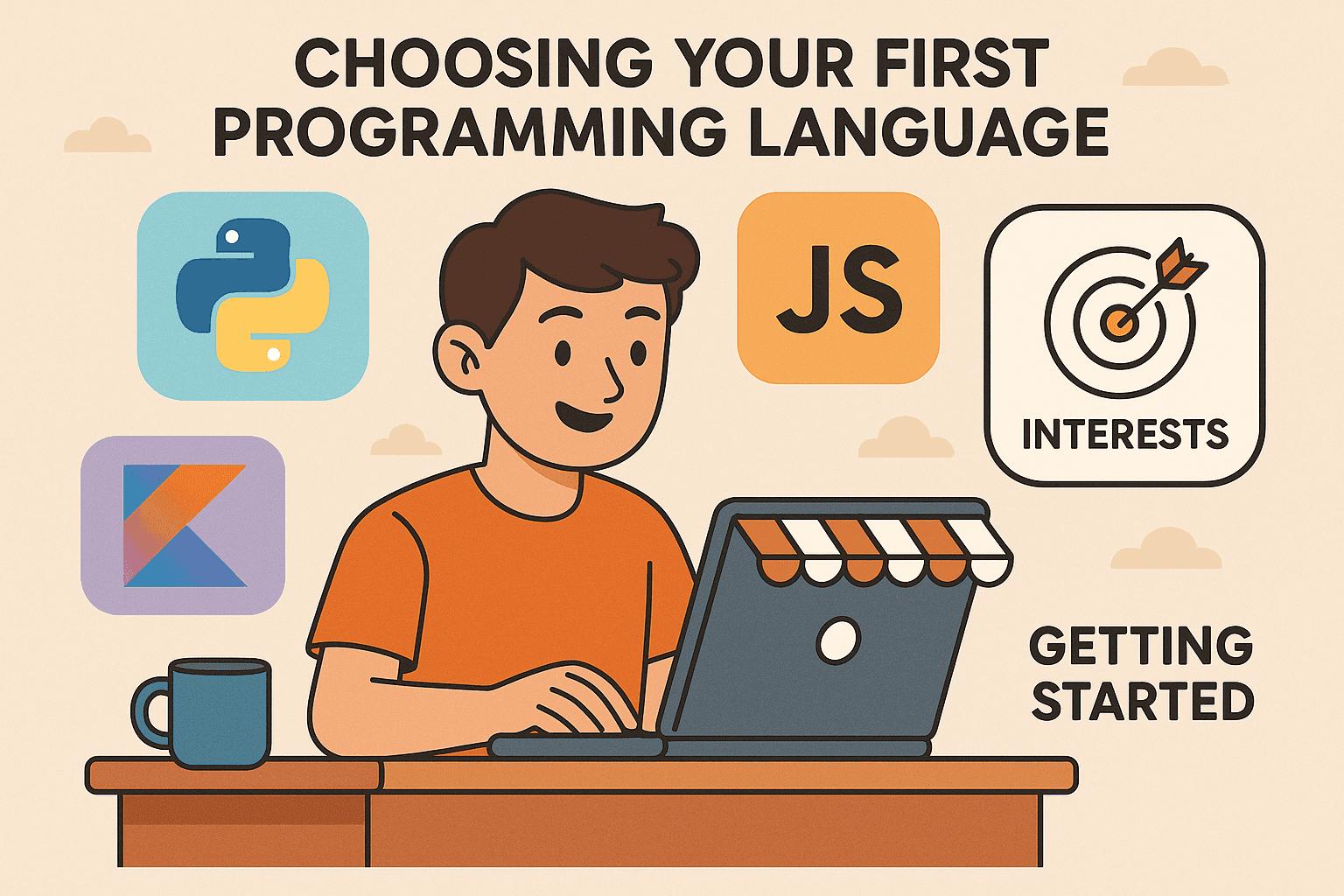
A programming language is a way to give instructions to a computer. Just like we use different languages to communicate with people, we use programming languages to communicate with computers.
For example, when we write "Hello World" in a program, the computer does not understand those words in the same way we do. A compiler, interpreter, or other programming tools convert the code into a form that the computer can execute.
Today, there are many programming languages such as Python, C, C++, Java, JavaScript, and C#. Every language has its own advantages and is used for different purposes.
Because there are so many languages available, a beginner can easily get confused about which one to learn first.
So, we decided to ask four people who are studying or are close to completing their studies in the computer science field.
Let's hear their opinions and experience and understand which programming language can be a good starting point for a beginner.
Let's welcome Harsh, Satish, Uday, and Kevin!
Let's Start the Conversation
Host: Hello everyone, welcome to PublicPodcast!
All: Hello, Namaste!
Host: I am going to ask you some simple questions about programming languages. Are you all ready?
All: Yeah, let's do it!
Host: If I want to learn a programming language, but I don't have a computer background—or imagine I am a first-year Computer Science Engineering student—which language would you suggest I learn first? And why?
Satish: I would suggest Python.
Python has simple and readable syntax, which makes it easier for beginners to understand. You can start writing basic programs without dealing with too many complicated rules.
Another good thing about Python is that it is used in many areas, such as web development, automation, data analysis, Artificial Intelligence, Machine Learning, and scripting.
So, after learning the basics, you can explore different areas using Python.
Host: What do you suggest, Kevin?
Kevin: I would suggest C language.
C is good for understanding the basic concepts of programming. It helps you learn concepts such as variables, loops, functions, arrays, pointers, and memory.
C is also widely used in embedded systems and microcontrollers. So, if you want to understand programming at a lower level, C can be a good language to start with.
Host: Uday, what do you suggest?
Uday: I would suggest Java.here
Java is a popular programming language and is used for many types of software applications. It is commonly used in backend development, enterprise applications, and large software projects.
Java is also useful for understanding object-oriented programming, where you learn concepts such as classes, objects, inheritance, and polymorphism.
Host: Harsh, you have been thinking for quite some time. Tell us your answer based on your experience.
Harsh: If you don't know any programming language, I would suggest starting with Python.
Python is relatively easy to start with because its syntax is simple and readable.
Java is also an important language and can be very useful, but if you are completely new to programming, I would prefer Python as the first language.
Python or Java: Which One Would You Choose?
Host: So, based on what you all have said, Python looks like a good choice for a beginner.
But Uday suggested Java. So, let's compare these two.
If you had to choose between Python and Java, which one would you choose as a beginner?
Harsh: I think Python is better for beginners because it is easier to start with.
Uday: I would choose Java. But I think it also depends on what you want to learn and what type of software you want to build.
Kevin: Python.
Host: Satish has an important call, so let's move forward.
I have one more question, and after that, we will end this discussion.
How Much Time Does It Take to Learn Python?
Host: How much time do you think a beginner needs to learn Python?
Kevin: I think around six months is enough for a beginner to become comfortable with Python if they study and practise regularly.
Uday: I would say 15 to 20 days is enough to learn the basics.
Host: Satish?
Satish: When you start learning programming, every language has different syntax, but many basic programming concepts are common.
For example, variables, conditions, loops, functions, and data structures are used in many programming languages.
So, if you understand these concepts properly and practise regularly, around 2 to 3 months can be enough to learn the basic concepts of Python.
But learning the basics is different from becoming good at the language. To become comfortable with Python, you need regular practice and some real projects.
Harsh: I would say around six months, especially if the person is completely new to programming and wants to build a strong foundation.
So, Which Programming Language Should a Beginner Learn?

After listening to everyone's opinions, we can see that Python was the most common choice for beginners in this discussion.
But does that mean Python is the best programming language for everyone?
Not necessarily.
The right programming language depends on what you want to learn and what you want to build.
For example:
Python: A good starting point for beginners and widely used in automation, data analysis, AI, Machine Learning, and web development.
C: A good choice for understanding programming fundamentals, memory, embedded systems, and microcontrollers.
Java: Useful for learning object-oriented programming and building backend, enterprise, and large software applications.
JavaScript: A major language for web development and is used to make websites interactive.
So, there is no single programming language that is the "best" for everyone.
If you are completely new to programming, Python can be a comfortable language to start with because its syntax is relatively simple.
If your goal is to understand programming fundamentals deeply, C can be a strong choice.
If you are interested in object-oriented programming and large software applications, Java can be a good option.
And if your main interest is web development, JavaScript is an important language to learn.
The most important thing is not just choosing a language. You should understand the basic programming concepts, practise regularly, and build small projects.
Once you understand these concepts, learning another programming language becomes easier because many fundamental ideas are common across different languages.